
The case is the complication
Every other house starts with a movement and builds a case around it. Richard Mille started with the case. Twenty-five years later that decision still explains everything about the watches.

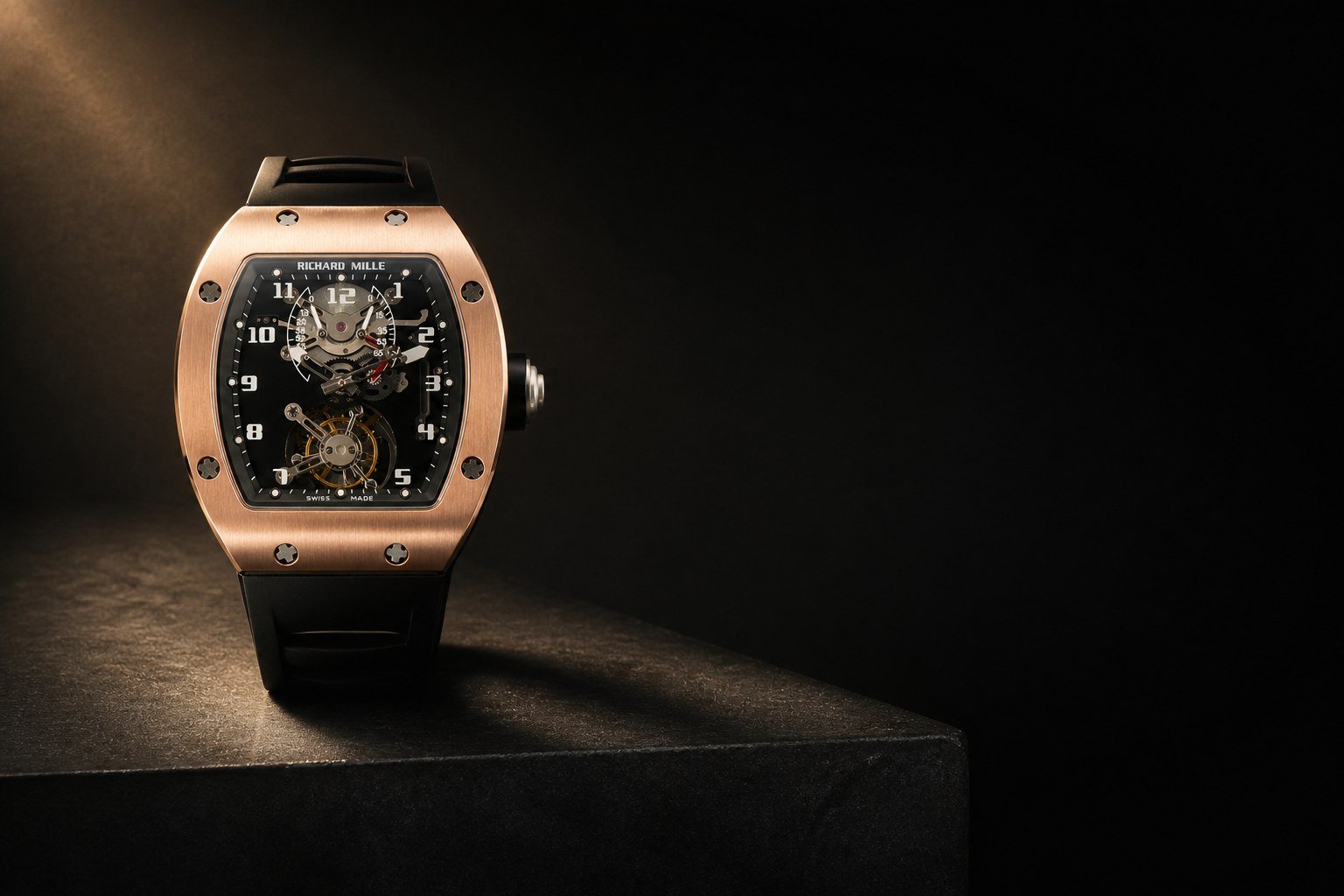
In 2001 a watch appeared that did not look like anything else in the room. It was not round, it was not thin, and the screws on the bezel were not decoration — they were the structure. The RM 001 is the first Richard Mille, and it announced the house’s whole argument in one object: the case is not a container, it is part of the mechanism.
What that actually means
In a conventional watch, the movement hangs inside a case that protects it. Richard Mille turned that around. The case is a chassis: it carries the movement, it takes the loads, and its shape is dictated by what the movement needs rather than by what a circle allows.
This is why the brand gives two dimensions instead of one. A 40.00 by 50.00 millimetre case is telling you something a 40 millimetre diameter cannot — that the watch is a rectangle with rounded shoulders, and that it will sit on the wrist differently from a round watch of the same width.
The dial is open because the movement is the view
A skeletonised dial is not a styling choice. Take the plate away and you are looking at the thing you paid for: the going train, the bridges, the barrel. It also means nothing can hide. Every finish, every screw, every edge is on display, which is a far harder standard than a closed dial.
Look at a Richard Mille from the front and you are effectively looking at its back.
Why the shapes keep changing
Because each reference is designed around a brief rather than a family. A tourbillon built for a tennis player, a split-seconds built for a sprinter, a flying tourbillon built for a collector — they do not share a case because they do not share a problem. The house has produced more distinct case architectures in twenty-five years than most brands produce in a century.
What to check before buying one
- The proportions. Confirm the two published dimensions against the piece, not the listing.
- The screws. They should be uniform in torque appearance and sit flush; uneven seating is the first thing that shows wear or poor service.
- The edges. A Richard Mille case is finished by hand on every face. Look along the flank in raking light for softness.
- The service record. These are technical watches. A documented service matters more than a box.
Where to start in our room
Three entry points, depending on what you want from it. The RM 001 is the origin and the purest statement of the idea. The RM 27-05 is the extreme version — a watch built to be worn while playing. The RM 35-03 is the one most people can live with daily, because its rotor adapts to how you move.
All three are on the shelf, photographed as they are.